
What makes a good time-lapse camera? well…., maybe we should slowly let the hammer back by starting somewhere a little different. Now if you already have a camera, that’s great!, there is a very good chance you can get started right away. But for those of you who do not yet have one you may want to ask yourself the following questions before making a final decision:
What do you want to do with your camera?
[aside]This post on DSLR, mirrorless and GoPros for timelapse is part of a larger road-map outlining timelapse photography called The Massive Time-lapse Photography How to Guide…[/aside]
It’s obvious that you are interested in time-lapse, but is that the only thing you want to photograph? Probably not. It’s really important to sit and think about your photographic interests, aspirations, and what you want to shoot, or film for that matter.
Where do you want to take yourself with photography?
Weekend warrior, full-time professional, enthusiast, hobbyist or fill_in_the_blank? One is not necessarily better or worse than the other, but having a clear idea of what you want to become is usually helpful in setting your camera and photography budget.
What is your budget?
Oh no… The dreaded “B” word. Few an enthusiasts is as gear lusty as the modern digital photographer, so do yourself a favor (and keep your spouse happy too!) by answering the above questions honestly and design a photography budget. It is really really hard, I know… I am learning time-lapse and working the Dave Ramsey plan at the same time so I know the importance of sticking to a plan. I’ll borrow a line from just about every camera training guide and video series out there: “It’s not the gear that makes a great photo, it’s the photographer.” Give Ansel Adams a coffee can, some electrical tape, a pin, and some film and he could make a great photo. But at the same time give him quality equipment and he could blow us out of the water. Quality gear matters but not as much as what you do with it.
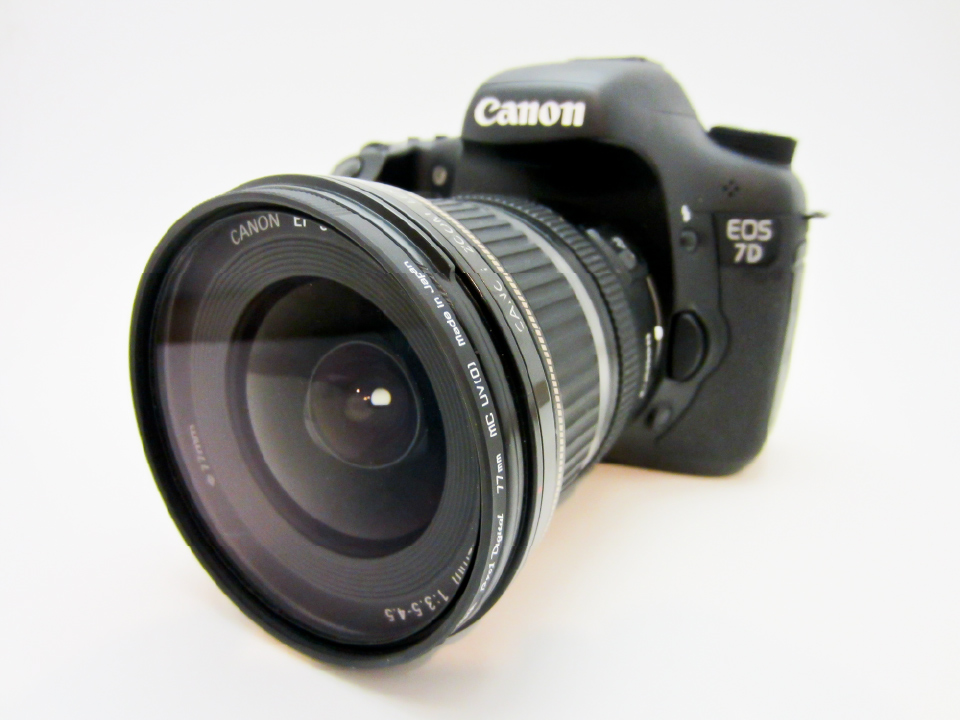
I’ve been using a Canon 7d for a while now.
I use a Canon 7d for my photography, time-lapse, and HD video work. Now, I am by no means immune to the twinges of more advanced models when browsing B&HPhoto 
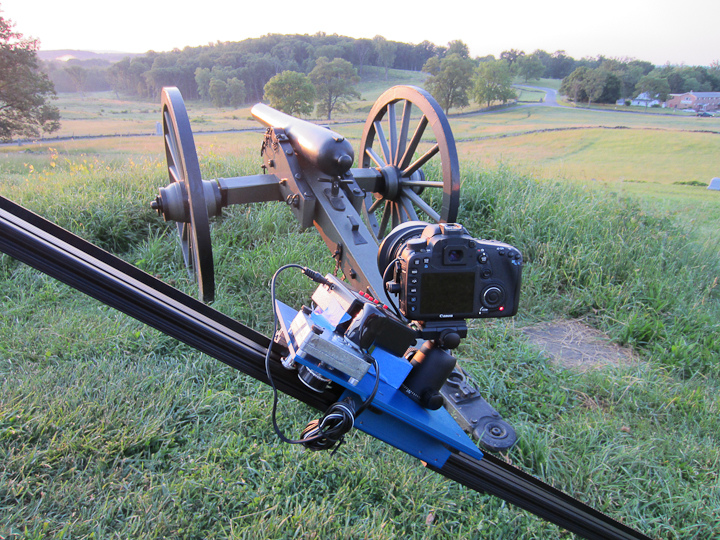
Here is my Canon 7D on the Dynamic Perception time-lapse dolly in Gettysburg Pennsylvania
I also have a GoPro.
My GoPro Hero 3+ is awesome fun. I am just starting to experiment with the timelapse functionality. Look for a specific writeup and review one GoPro timelapse soon.
But I think my new favorite is the Sony A7s.
I’ve rented a Sony a7s on a few occasions now and am continually blown away by the simplicity and amazing low light capabilities for astrophotography and astro-timelapse. I’ll be frank and say I’m a little apprehensive to switch main manufactures after having so much Canon gear. My project now is to continue evaluating and weighing the cost to switch/adapt. An upgrade may be coming soon.
Here are a few things to consider:
Quality comes in at number 1. Right now there is a wide range of cameras available by several high quality manufacturers. From my point of view, Nikon and Canon DSLRs are still top notch and have received very high reviews from many friends and photographers all over the board. Sony is creeping in and the Panasonic GH4 is no small matter either. While there are others that make great cameras, you can’t go wrong with either of these manufacturers.
Here are a few things to consider as it relates to time-lapse capture (specifically for DSLR cameras):
- Can I use an intervalometer?
- Since we haven’t discussed this much yet, an intervalometer is software or an external device (also called a timer remote control) that allows the photographer to program multiple camera exposures according to a set time-frame. In other words its the heart of time-lapse photography. Imagine trying to press the shutter manually every 3 seconds for 20 minutes.
- Your camera must either have a built-in intervalometer function or be able to accept a remote connection/remote control (most Cameras do not have a built in function, I use an Satechi TR-A Timer Remote Control for my 7d)
- How do I know what’s available for my camera? It’s not elegant but the easiest way is to google: “[your camera make and model] intervalometer”. The results should lead to a place to purchase one or to info contained in the cameras manual.
- Do you want to photograph star trails or star lapses?
- If you really want to experiment with astrophotography you may want to consider a full frame DSLR camera. DSLRs labeled as a “full frame” (roughly 24mm x 36mm) generally provide better image quality and really tout their muscle when it comes to high ISO and night photography. In a nutshell they have larger image sensors which allow
- Be prepared they are more expensive. My canon 7d is a crop senor (1.6x magnification) which helps for telephoto shooting but it lacks that extra bang for wide angle and astrophotography.
- I encourage you to learn much more about the different types. Here are a few good resources: Full Frame vs. Crop, To crop or not to crop

I encourage you to comment on your experiences below as well as take advantage of the following great resources:
- How to choose a DSLR camera – Digital Photography School
- The best digital SLR camera for YOU – The Digital SLR Guide
- Choosing an SLR camera – Photo.net
I know I may have left with more questions than answers here, but I promise that’s ok. Read reviews, make a decision and relax. Start having fun shooting because you’ve made the right decision. There will always be something better, something newer…
Return to The Massive Time-lapse Photography Tutorial:
[includepost id=”177″][/includepost]
One big advantage to Canon over Nikon is the ability to shoot in RAW with a small image size. Nikon has only one size of RAW image file and while they have a lossless compression you can’t get a 2~3 megapixel 12bit RAW image from a Nikon. Most all Nikon have a built-in Intervolomimeter, that too is limited because to maximum number of intervals is limited to 999. I would agree that the Canon 5D MII the best camera for time lapse.
with high-end DSLR, how do you consider the shutter lifetime? It can be worn off pretty quickly than normal use.
I worry about that too. But when you crunch the numbers, the cost doesn’t come out too bad. A brand new T3i is currently 499 at Amazon, that works out to $0.0049/actuation(if you take Canon’s published 100,000 actuation lifetime. So a 60second/24fps time lapse video would end up “costing” 1,440 frames*.0049 or $7.056. See, not too bad!
Hey, Im thinking of buying a camera for selfuse, I have no knowledge when it comes to fotografi but im thinking of making a time lapse film for my schoolproject and I was wondering what cameras I should use, as a poor student? any suggestions? sorry my bad english.
[…] Things to consider when buying a timelapse camera What cameras I use for timelapse (expanded section in the works) Timelapse Camera Reviews Specific reviews (links/videos/writeups in the works): […]
[…] Some best time lapse cameras like Brinno TLC200 Pro HDR, Go Pro HERO will worth your try. Learn how to choose the best time lapse cameras here>> […]